

 Español
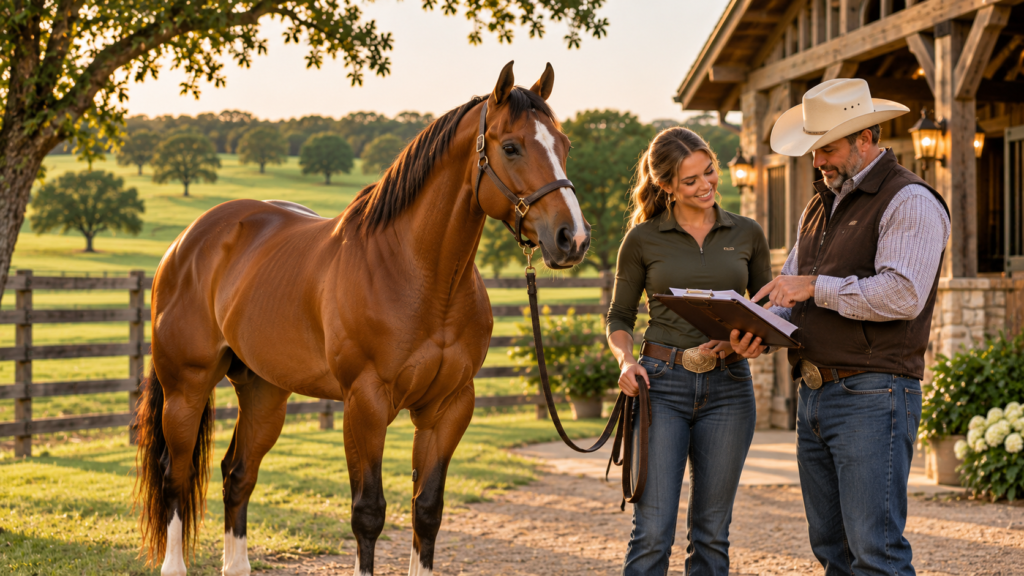
When searching for AQHA registered horses for sale, serious buyers look far beyond basic riding training or coat color. Purchasing an American Quarter Horse represents a significant financial and emotional investment. Whether you are looking for an arena prospect, a trail partner, or an addition to a breeding program, two critical factors establish a horse’s baseline value, health foundation, and lineage: verified American Quarter Horse Association (AQHA) registration and a comprehensive 6-Panel Genetic Test.
Understanding how to verify registration documentation, interpret genetic panel results, and evaluate pedigree history helps buyers make informed decisions and reduces risks associated with inherited conditions. At 4 Stallions Ranch in Jonesboro, Georgia, our family-owned operation prioritizes genetic transparency, documented parentage, and clear communication regarding every horse we offer. Below is an in-depth guide covering what AQHA registration entails, what the AQHA 6-panel genetic test screens for, how to perform an AQHA registration lookup, and how to evaluate genetic information when purchasing your next Quarter Horse.
1. What Is AQHA Registration and Why Does It Matter?
An official AQHA Certificate of Registration serves as verified proof of parentage, age, ownership history, and documented lineage tracing back generations to foundational performance lines.
How to Perform an AQHA Registration Lookup
- Obtain the horse’s official registered name and AQHA registration number.
- Confirm that the seller matches the owner of record or holds a signed transfer report.
- Verify sire, dam, performance records, and genetic test filings on the AQHA portal.
- Inspect physical gold AQHA seals and microchip/tattoo markings.
2. Understanding 6-Panel Genetic Testing (Including MYHM)
The AQHA officially recognizes a 6-Panel Genetic Test that screens for six hereditary conditions:
THE AQHA 6-PANEL GENETIC TEST:
- HYPP — Hyperkalemic Periodic Paralysis (Dominant sodium channel defect causing muscle tremors)
- HERDA — Hereditary Equine Regional Dermal Asthenia (Recessive collagen defect separating skin)
- GBED — Glycogen Branching Enzyme Deficiency (Recessive fatal enzyme defect in foals)
- PSSM1 — Polysaccharide Storage Myopathy Type 1 (Dominant muscle starch accumulation)
- MH — Malignant Hyperthermia (Dominant metabolic temperature spike under stress/anesthesia)
- MYHM — Myosin-Heavy Chain Myopathy (Codominant muscle protein mutation causing Immune-Mediated Myositis (IMM))
3. How Genetic Testing Helps Reduce Risk for Buyers
Requesting genetic panel details reduces inherited disease risks, prevents crossing two recessive carriers in future breeding, and avoids medical surprises.
4. Documented Lineage and Transparency at 4 Stallions Ranch
We openly share registration papers and health records for featured herd members: Discos Last Time ($15,000 registered AQHA mare), Lillianna ($30,000 registered AQHA mare), Shine San Peppy ($18,000 prospect), and Gun Sixty Six ($25,000 prospect) (prices subject to market rates).
EXPLORE QUALITY AQHA QUARTER HORSES IN GEORGIA
Contact 4 Stallions Ranch today at 404.729.1930, visit 2479 Freeman Rd. Jonesboro, GA, or browse 4stallionsranch.com!
