

 Español
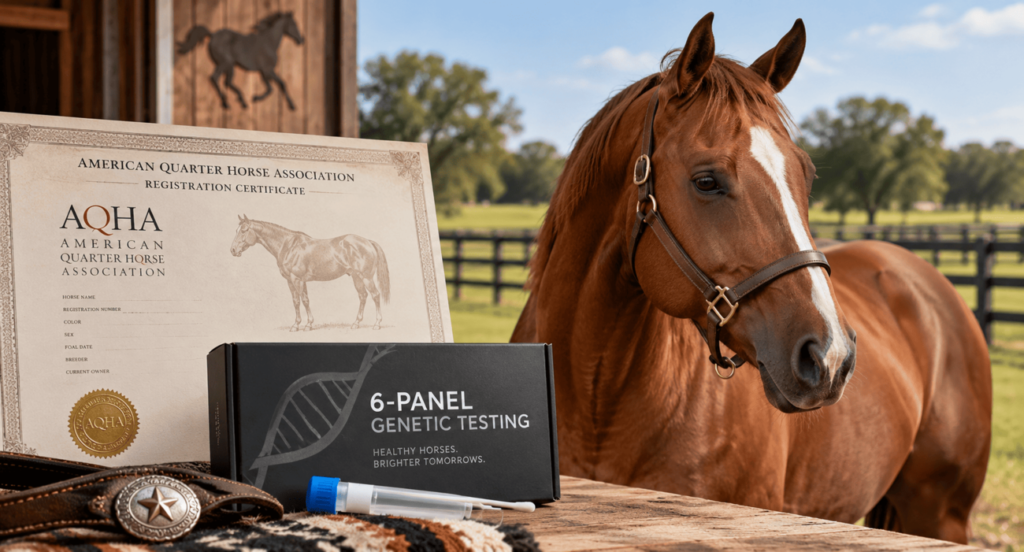
When searching for AQHA registered horses for sale, serious buyers look far beyond basic riding training or coat color. Purchasing an American Quarter Horse represents a significant financial and emotional investment. Whether you are looking for an arena prospect, a trail partner, or an addition to a breeding program, two critical factors establish a horse’s baseline value, health foundation, and lineage: verified American Quarter Horse Association (AQHA) registration and a comprehensive 6-Panel Genetic Test.
Understanding how to verify registration documentation, interpret genetic panel results, and evaluate pedigree history helps buyers make informed decisions and reduces risks associated with inherited conditions. At 4 Stallions Ranch in Jonesboro, Georgia, our family-owned operation prioritizes genetic transparency, documented parentage, and clear communication regarding every horse we offer.
Below is an in-depth guide covering what AQHA registration entails, what the AQHA 6-panel genetic test screens for, how to perform an AQHA registration lookup, and how to evaluate genetic information when purchasing your next Quarter Horse.
What Is AQHA Registration and Why Does It Matter?
The American Quarter Horse Association (AQHA) maintains the world’s largest equine breed registry. An official AQHA Certificate of Registration serves as verified proof of a horse’s parentage, age, ownership history, and documented lineage.
When evaluating an AQHA registered horse, verified registration papers provide documented lineage tracing back generations to foundational performance lines. Rather than offering absolute guarantees, a verified pedigree gives buyers predictable insights into an animal’s athletic potential, structural tendencies, and disposition.
How to Perform an AQHA Registration Lookup
Before finalizing a purchase, buyers should verify a seller’s claims by performing an official AQHA registration lookup:
- Obtain the Registration Details: Request the horse’s official registered name and AQHA registration number.
- Verify Ownership: Confirm that the current seller matches the owner of record on the certificate or holds a signed transfer report.
- Check Official Records: Use the AQHA online portal to look up sire and dam details, official performance records, and filed genetic test results.
- Inspect the Certificate: Ensure the physical certificate carries the official gold AQHA seal and matches the horse’s physical markings or microchip/tattoo identifiers.
Understanding 6-Panel Genetic Testing (Including MYHM)
Quarter Horse breeding historically involved line-breeding for specialized athletic traits, which allowed certain recessive and dominant genetic mutations to persist within specific bloodlines.
While genetic testing previously focused on a 5-panel panel, the AQHA now recognizes a 6-Panel Genetic Test that includes MYHM. A 6-panel test identifies whether an individual horse is Clean (N/N), a Carrier (N/Genetic Code), or Affected by any of these six hereditary conditions:
| THE AQHA 6-PANEL GENETIC TEST | |
|---|---|
| 1. HYPP | — Hyperkalemic Periodic Paralysis |
| 2. HERDA | — Hereditary Equine Regional Dermal Asthenia |
| 3. GBED | — Glycogen Branching Enzyme Deficiency |
| 4. PSSM1 | — Polysaccharide Storage Myopathy Type 1 |
| 5. MH | — Malignant Hyperthermia |
| 6. MYHM | — Myosin-Heavy Chain Myopathy |
Breakdown of the 6 Genetic Panel Conditions
Understanding what each test screens for helps buyers evaluate potential health management needs:
1. HYPP (Hyperkalemic Periodic Paralysis)
- Inheritance: Autosomal Dominant (a horse only needs one copy to express symptoms).
- Description: Causes a sodium channel defect in muscle cells, leading to muscle tremors, weakness, and potential respiratory distress.
- Management: Affected horses require strict dietary management (low potassium) and specialized care.
2. HERDA (Hereditary Equine Regional Dermal Asthenia)
- Inheritance: Autosomal Recessive (requires a copy from both sire and dam).
- Description: Weakens collagen binding the skin to the body, often manifesting when a horse is started under saddle and causing severe skin lesions.
- Impact: Affected horses (HRD/HRD) cannot comfortably support a saddle and rider.
3. GBED (Glycogen Branching Enzyme Deficiency)
- Inheritance: Autosomal Recessive.
- Description: Prevents the body from properly storing and utilizing glycogen in critical organs and skeletal muscle.
- Impact: Foals carrying two copies of GBED rarely survive past the first few weeks of life.
4. PSSM1 (Polysaccharide Storage Myopathy Type 1)
- Inheritance: Autosomal Dominant.
- Description: Causes muscle cells to accumulate abnormal starches, triggering muscle stiffness, cramping, and tie-up episodes.
- Management: Requires specialized low-starch, high-fat diets and structured daily exercise routines.
5. MH (Malignant Hyperthermia)
- Inheritance: Autosomal Dominant.
- Description: Triggers severe metabolic reactions, rapid temperature spikes, and muscle rigidity under stress, extreme exertion, or surgical anesthesia.
6. MYHM (Myosin-Heavy Chain Myopathy)
- Inheritance: Codominant.
- Description: A genetic variant affecting muscle protein. It can cause Immune-Mediated Myositis (IMM), leading to rapid muscle wasting following viral exposure or vaccinations, as well as severe non-exertional rhabdomyolysis.
- Management: Early identification allows veterinarians to manage immune responses and tailor vaccination/medication schedules appropriately.
How Genetic Testing Helps Reduce Risk for Buyers
While no test can guarantee absolute soundness or performance, requesting genetic testing details provides distinct risk-management advantages:
- Reduces Risks of Inherited Disorders: Helps ensure you avoid unexpected conditions like HERDA or PSSM1 that could hinder training or ridden work.
- Supports Responsible Breeding: If you intend to breed in the future, knowing a horse’s genetic status prevents breeding two carriers together, eliminating the risk of producing an affected GBED or HERDA foal.
- Promotes Genetic Transparency: Openly sharing panel results—or the test status of sire and dam—builds trust between buyers and breeders.
- Prevents Medical Surprises: Helps owners prepare tailored nutritional, exercise, or health plans suited to their horse’s individual profile.
What to Ask When Evaluating a Horse’s Genetic Status
Because testing practices vary across the industry and not every horse will have full 6-panel results on file, buyers should feel empowered to ask informed questions:
- “Has this specific horse or its sire and dam been tested for the AQHA genetic panel?”
- “Are registration numbers available so I can verify filed test results or parentage through AQHA?”
- “Can genetic testing be included as part of a pre-purchase veterinary examination?”
An honest breeder will gladly share available registration papers, parentage records, and health documentation, or discuss testing options openly.
Documented Lineage and Transparency at 4 Stallions Ranch
At 4 Stallions Ranch in Jonesboro, Georgia, our breeding philosophy centers around athletic bloodlines, structural balance, and documented parentage. We strive for transparency regarding the registration and genetic status of every horse we offer.
Because our herd includes both registered adult mares and young prospects with registration or testing in process, we provide clear information on individual listings so buyers know exactly where each horse stands:
- Discos Last Time ($15,000): Adult registered AQHA mare featuring documented pedigree, athletic conformation, and a balanced temperament.
- Lillianna ($30,000): Registered AQHA mare offering verified papers and performance potential for arena or breeding pursuits.
- Shine San Peppy ($18,000): 2026 AQHA mare prospect with registration processing underway.
- Gun Sixty Six ($25,000): 2026 AQHA stallion prospect descended from reining and cutting lines, with registration processing underway.
Explore Quality AQHA Quarter Horses in Georgia
Choosing your next Quarter Horse should be grounded in clear information, verified documentation, and open communication.
Contact 4 Stallions Ranch today at (404) 729-1930, visit our ranch at 2479 Freeman Rd. Jonesboro, GA 30236, or browse our current AQHA Horses for Sale to view individual listings, review pedigree records, and schedule a private visit!
